
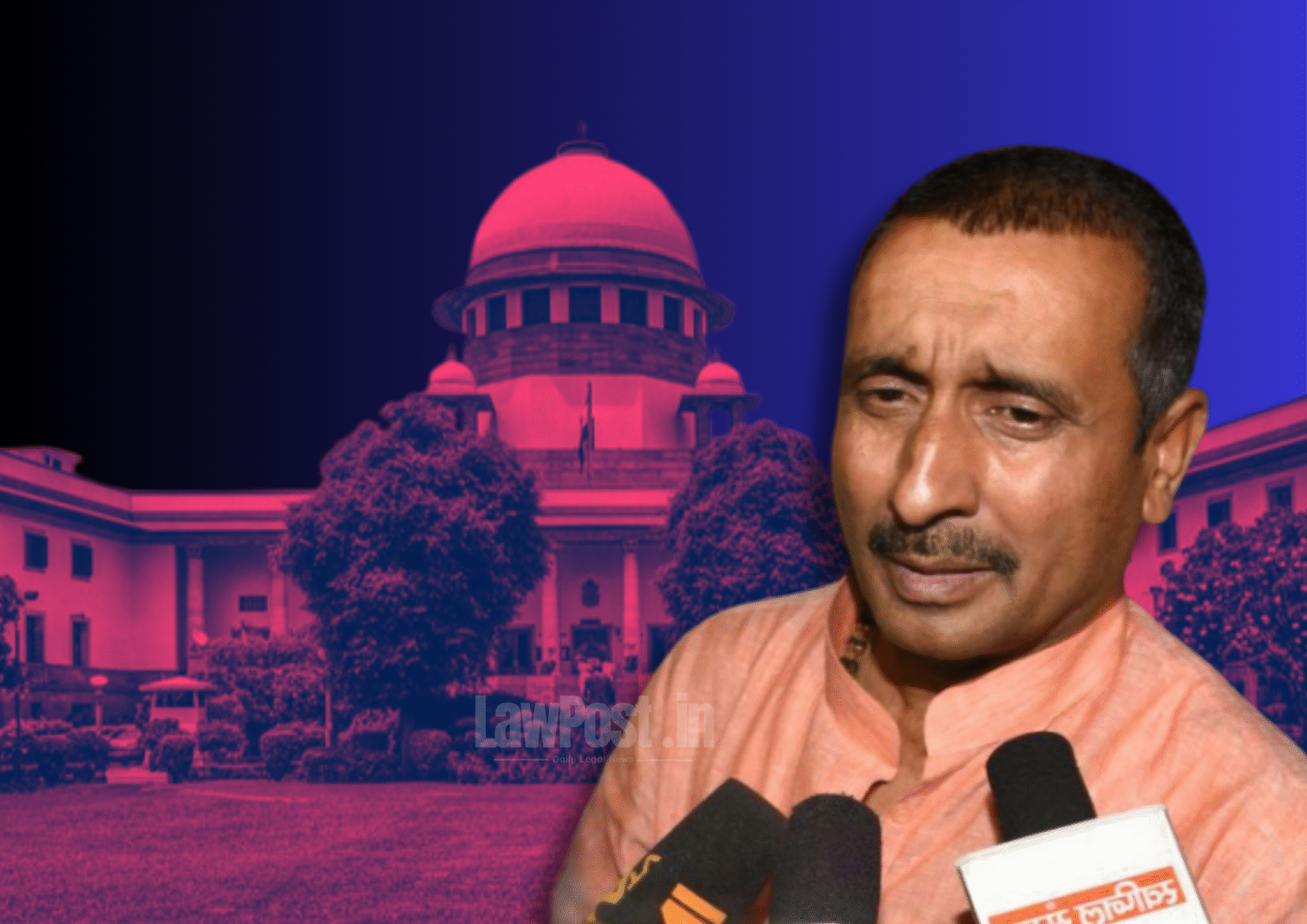
The Supreme Court of India on Monday stayed the operation of the Delhi High Court order granting bail and suspending the life sentence of former Uttar Pradesh MLA Kuldeep Singh Sengar in the Unnao rape case, expressing serious concern over the High Court’s interpretation of the law.
A vacation bench comprising Chief Justice of India Surya Kant, Justice J.K. Maheshwari and Justice Augustine George Masih issued notice to Sengar on an appeal filed by the Central Bureau of Investigation, and directed that he shall not be released from jail pursuant to the High Court’s December 23 order.
“We find that there are various substantial questions of law which arise… In view of the peculiar facts, where the convict is already convicted for a separate offence, we stay the operation of the Delhi High Court order dated December 23 and the respondent shall not be released pursuant to the said order,” the Supreme Court said.
Concern Over Interpretation of ‘Public Servant’
The apex court raised strong reservations about the High Court’s interpretation of the term ‘public servant’ under Section 5 of the Protection of Children from Sexual Offences Act (POCSO Act), warning that such an interpretation could have far-reaching consequences.
“We are worried that a constable shall be a public servant under the Act but a Member of Legislative Assembly will be excluded,” the Court remarked, adding that while the High Court judges are “some of the finest judges,” courts are “all prone to committing errors.”
Background of the Case
Sengar was convicted by a Delhi trial court in December 2019 for offences under the Indian Penal Code and the POCSO Act for raping a minor, and was sentenced to imprisonment for the remainder of his natural life. The trial court held that he committed aggravated penetrative sexual assault on the ground that he fell within the definition of a “public servant.”
However, a Division Bench of the Delhi High Court had suspended his sentence and granted bail, holding that Sengar could not be treated as a public servant under Section 5(c) of the POCSO Act or Section 376(2)(b) of the IPC, and that he did not fall within the category of a person in a “position of trust or authority” under Section 5(p) of the POCSO Act.
CBI’s Arguments Before the Supreme Court
Appearing for the CBI, Solicitor General Tushar Mehta described the case as a “horrific rape of a child” and argued that the High Court committed a grave error in law.
“This is a case where the child was 15 years and 10 months old. Conviction is on two counts and the appeal against conviction is still pending,” Mehta told the Court.
He further contended that a sitting MLA occupies a constitutional position of trust and authority and performs public duties in which the State and society have a direct interest. The CBI also highlighted concerns over the safety of the survivor and her family, noting Sengar’s influence and past conduct.
“I urge the conscience of this Court to stay this order for the sake of the child who was the victim,” Mehta submitted, also pointing out that Sengar stands convicted in the murder of the victim’s father.
Defence’s Stand
Senior Advocates Siddhartha Dave and N. Hariharan, appearing for Sengar, opposed the CBI’s plea, arguing that the life sentence was imposed solely because Sengar was treated as a public servant.
“Sentencing was granted only because he fell under the definition of public servant,” Dave argued, while Hariharan submitted that “a penal statute cannot import definitions from another statute.”
Court Condemns Attacks on Judges
During the hearing, concerns were raised about attempts on social media to target the High Court judges who granted bail. The Solicitor General strongly defended the judges.
“They are few of the finest judges of the country with unimpeachable integrity. Any attempt to malign them must be strongly condemned,” Mehta said, a view echoed by the Court.
What Lies Ahead
With the Supreme Court staying the High Court’s order, Sengar will remain in jail while the appeal is heard. The case is now set to test critical questions of law, including the scope of the term ‘public servant’ under the POCSO Act and the standards governing suspension of sentence in cases involving sexual offences against children.
Case: CBI vs Kuldeep Singh Sengar- Available on LAWFYI.IO